

Traces
A trace represents one complete interaction between a user and your agent. It’s the primary unit that Latitude’s reliability features operate on: evaluations, annotations, and signals all reference traces.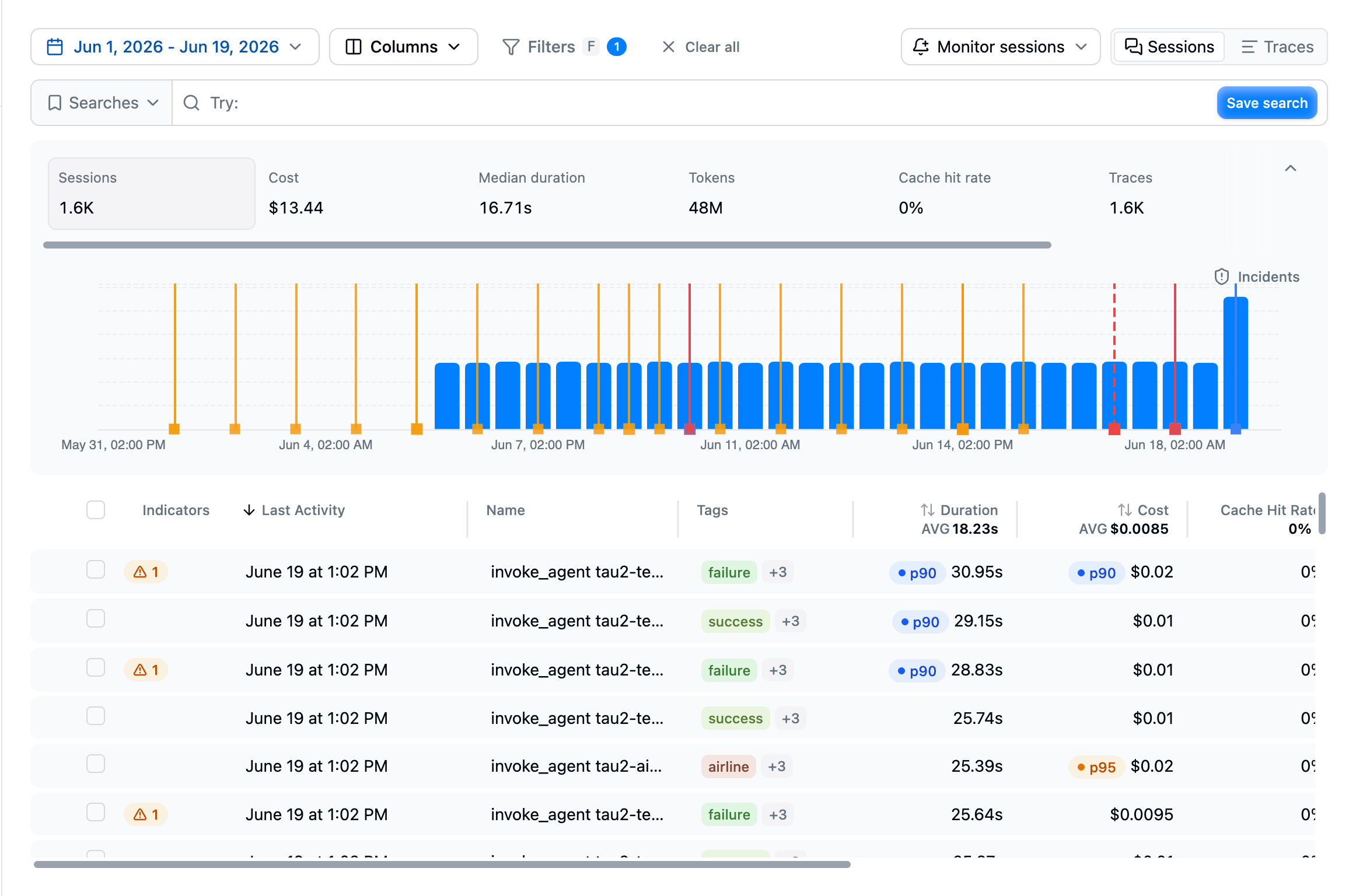
What’s in a Trace
A trace is composed of one or more spans: the individual operations your agent performed. A typical trace might include:- An incoming user message
- One or more LLM calls
- Tool invocations (search, database queries, API calls)
- Retrieval operations
- The final agent response
- Root span name: The top-level operation name
- Overall status: OK or error, derived from constituent spans
- Total duration: End-to-end timing
- Aggregated tokens: Total input and output tokens across all LLM calls
- Aggregated cost: Total cost across all provider calls
- Span count: How many individual operations were involved
- Error count: How many spans errored
- Models and providers: Which LLMs and providers were used
- Tags and metadata: Custom labels and structured metadata
Trace completion
Latitude waits until a trace has finished before using it in downstream workflows. This keeps search, evaluations, flaggers, and signal discovery focused on complete interactions rather than partial agent runs. Once a trace is complete, Latitude can:- make it available in Search
- run matching Evaluations
- apply enabled Flaggers
- connect resulting Scores to Signals
Viewing Traces
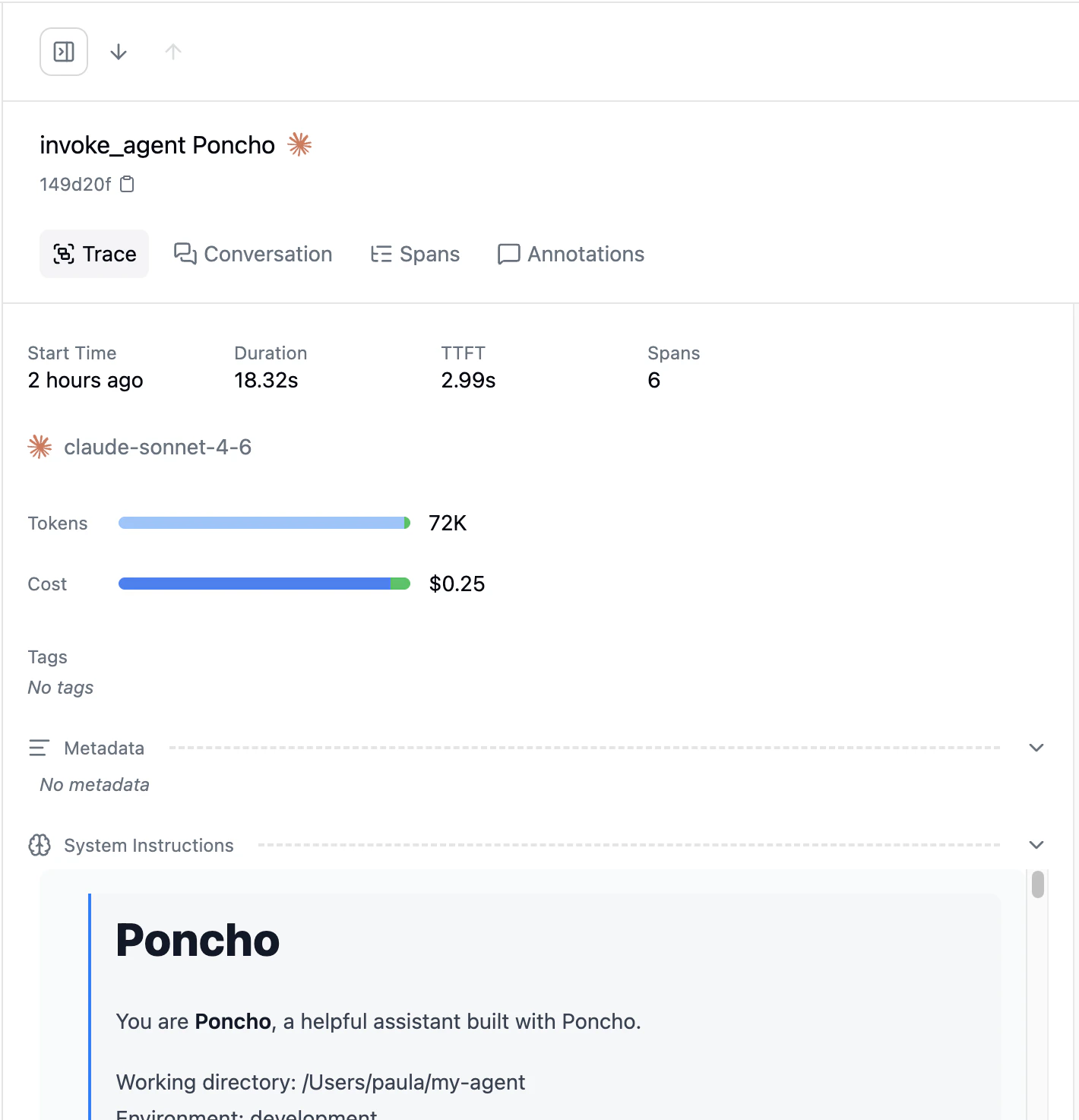
The Traces page in your project shows a table of all traces, newest first. Each row displays key metadata at a glance: name, status, duration, cost, tokens, and timestamp. Click on a trace to open the detail view, which shows:- The full conversation: All messages exchanged between user and agent
- The span tree: A hierarchical view of every operation your agent performed
- Scores: Any evaluation, annotation, or custom scores attached to this trace
- Metadata: Custom fields, timing details, and resource usage
Searching and Filtering Traces
The project Search page lets you search trace conversations in three ways. You can combine them in one query:- Semantic search: write normal text without quotes. Latitude searches by meaning and ranks matching traces first. Example:
customer wants a refundcan find traces where the user says “I need my money back” even if the exact words differ. - Literal match: wrap text in double quotes. Latitude looks for that exact case-sensitive text in the searchable conversation. Example:
"handOffToHuman: true"matches that exact string. - Phrase match: wrap text in backticks. Latitude searches for those words next to each other and in order, while ignoring case and punctuation between them. Example:
`human-annotation`can matchhuman-annotation,Human annotation, or"human": "annotation", but nothuman something annotation.
handOffToHuman: true, contain the adjacent phrase tokens human and annotation, and ranks the remaining matches by how semantically close they are to refund.
Click the Filters button in the toolbar to open the filter panel. The panel organizes filters into functional groups (Identity, Status, Models & tools, Performance & cost, Conversation, Scores, and Custom), and the search box at the top matches both group and filter names. You can combine any number of filters with search to narrow your trace view.
Available Filters
Status
Status
Filter traces by their completion status. Select one or more:
- OK: Trace completed without errors
- ERROR: At least one span in the trace errored
- UNSET: Status was not reported
Name
Name
Filter by the root span name (the
path you set in capture()). Type a name to match.Session ID
Session ID
Filter traces belonging to a specific session. Useful for viewing the full history of a multi-turn conversation.
Simulation ID
Simulation ID
Filter traces generated by a specific simulation run.
User ID
User ID
Filter traces by end-user identifier, if your application passes one via telemetry metadata.
Models
Models
Filter by the LLM model(s) used in the trace (e.g.
gpt-4o, claude-3.5-sonnet). Search and select from models seen in your project.Providers
Providers
Filter by the LLM provider(s) used (e.g. OpenAI, Anthropic, Azure). Search and select from providers seen in your project.
Services
Services
Filter by the service name reported by OpenTelemetry instrumentation.
Duration
Duration
Set a min/max range to filter traces by total duration.
TTFT (Time to First Token)
TTFT (Time to First Token)
Set a min/max range to filter by time to first token. This is useful for identifying slow-starting responses.
Cost
Cost
Set a min/max range to filter by estimated total cost. Useful for finding expensive traces.
Span Count
Span Count
Set a min/max range for the number of spans in a trace. Higher span counts typically indicate more complex agent operations.
Error Count
Error Count
Set a min/max range for the number of errored spans within a trace.
Tokens Input
Tokens Input
Set a min/max range for total input tokens across all LLM calls in the trace.
Tokens Output
Tokens Output
Set a min/max range for total output tokens across all LLM calls in the trace.
Metadata
Metadata
Filter by custom key-value metadata. Add one or more conditions in the form
key = value. This matches against the structured metadata your application sends with its telemetry.Combining Filters
All active filters are combined with AND logic. Traces must match every active filter to appear. For example:- Status = ERROR AND Cost > $1: find expensive failures
- Models = gpt-4o AND Duration > 5s: find slow GPT-4o traces
- Metadata
environment=productionAND Error Count > 0: find production errors
Traces and Sessions
When your application provides asession_id with its telemetry, Latitude groups related traces into sessions. You can filter traces by session ID to see the full conversation history, or switch to the Sessions tab on the Traces page for a session-focused view.
Next Steps
- Sessions: Session-level conversations and aggregation
- Search: Find traces by meaning, not just metadata
- Scores: How scores attach to traces
- Annotations: Annotating directly from trace views